Sort by:
2051 products
2051 products
Knife Information
1894- Mr. Tasaburo Shigematsu, a hardware wholesaler, introduced a new pocket knife with its blade and sheath folded by installing a small handle “Chikiri (tail)” on the blade, while inspired by the knife he brought back from Kagoshima.
He named it “Higonokami Knife” because many of his customers were in Kumamoto area (formally Higo country), which turned out to dramatically increase his sales. The blades have gradually changed their shapes. Unlike single-edged knives, the double-edged blades (V-shaped cross section) were in those days considered common. The earlier blades had a sharper tip (shape of a bamboo leaf), but now they have square shapes. The sheaths had a vertically folding style and a cross folding style, now the vertical one has to be custom made.
In 1911, at the First Kobe Export Articles Competitive Exhibition, Crown Prince (later Emperor Taisho) liked Higonokami on display very much and bought one, which is said to have helped its fame further spread.
The Higonikami is a fantastic traditional utility knife at a low cost.
Specifications
| Style: | Higonokami |
| Blade Length: | 74mm |
| Weight: | 53g |
| Bevel: | Double Bevel |
| Blade Material: | Laminated SK Carbon Steel |
| Handle Material: | Black Nickel |
Knife Information
1894- Mr. Tasaburo Shigematsu, a hardware wholesaler, introduced a new pocket knife with its blade and sheath folded by installing a small handle “Chikiri (tail)” on the blade, while inspired by the knife he brought back from Kagoshima.
He named it “Higonokami Knife” because many of his customers were in Kumamoto area (formally Higo country), which turned out to dramatically increase his sales. The blades have gradually changed their shapes. Unlike single-edged knives, the double-edged blades (V-shaped cross section) were in those days considered common. The earlier blades had a sharper tip (shape of a bamboo leaf), but now they have square shapes. The sheaths had a vertically folding style and a cross folding style, now the vertical one has to be custom made.
In 1911, at the First Kobe Export Articles Competitive Exhibition, Crown Prince (later Emperor Taisho) liked Higonokami on display very much and bought one, which is said to have helped its fame further spread.
The Higonikami is a fantastic traditional utility knife at a low cost.
Specifications
| Style: | Higonokami |
| Blade Length: | 65mm |
| Weight: | 33g |
| Bevel: | Double Bevel |
| Blade Material: | Laminated SK Carbon Steel |
| Handle Material: | Black Nickel |
Knife Information
1894- Mr. Tasaburo Shigematsu, a hardware wholesaler, introduced a new pocket knife with its blade and sheath folded by installing a small handle “Chikiri (tail)” on the blade, while inspired by the knife he brought back from Kagoshima.
He named it “Higonokami Knife” because many of his customers were in Kumamoto area (formally Higo country), which turned out to dramatically increase his sales. The blades have gradually changed their shapes. Unlike single-edged knives, the double-edged blades (V-shaped cross section) were in those days considered common. The earlier blades had a sharper tip (shape of a bamboo leaf), but now they have square shapes. The sheaths had a vertically folding style and a cross folding style, now the vertical one has to be custom made.
In 1911, at the First Kobe Export Articles Competitive Exhibition, Crown Prince (later Emperor Taisho) liked Higonokami on display very much and bought one, which is said to have helped its fame further spread.
The Higonikami is a fantastic traditional utility knife at a low cost.
Specifications
| Style: | Higonokami |
| Blade Length: | 65mm |
| Casing Length: | 90mm |
| Casing Width: | 15mm |
| Weight: | 33g |
| Bevel: | Double Bevel |
| Blade Material: | Laminated SK Carbon Steel Nashiji Finish |
| Handle Material: | Black Steel |
Knife Information
1894- Mr. Tasaburo Shigematsu, a hardware wholesaler, introduced a new pocket knife with its blade and sheath folded by installing a small handle “Chikiri (tail)” on the blade, while inspired by the knife he brought back from Kagoshima.
He named it “Higonokami Knife” because many of his customers were in Kumamoto area (formally Higo country), which turned out to dramatically increase his sales. The blades have gradually changed their shapes. Unlike single-edged knives, the double-edged blades (V-shaped cross section) were in those days considered common. The earlier blades had a sharper tip (shape of a bamboo leaf), but now they have square shapes. The sheaths had a vertically folding style and a cross folding style, now the vertical one has to be custom made.
In 1911, at the First Kobe Export Articles Competitive Exhibition, Crown Prince (later Emperor Taisho) liked Higonokami on display very much and bought one, which is said to have helped its fame further spread.
The Higonikami is a fantastic traditional utility knife at a low cost.
Specifications
| Style: | Higonokami |
| Blade Length: | 65mm |
| Weight: | 33g |
| Bevel: | Double Bevel |
| Blade Material: | Laminated SK Carbon Steel |
| Handle Material: | Semi-Polished Steel |
Knife Information
1894- Mr. Tasaburo Shigematsu, a hardware wholesaler, introduced a new pocket knife with its blade and sheath folded by installing a small handle “Chikiri (tail)” on the blade, while inspired by the knife he brought back from Kagoshima.
He named it “Higonokami Knife” because many of his customers were in Kumamoto area (formally Higo country), which turned out to dramatically increase his sales. The blades have gradually changed their shapes. Unlike single-edged knives, the double-edged blades (V-shaped cross section) were in those days considered common. The earlier blades had a sharper tip (shape of a bamboo leaf), but now they have square shapes. The sheaths had a vertically folding style and a cross folding style, now the vertical one has to be custom made.
In 1911, at the First Kobe Export Articles Competitive Exhibition, Crown Prince (later Emperor Taisho) liked Higonokami on display very much and bought one, which is said to have helped its fame further spread.
The Higonikami is a fantastic traditional utility knife at a low cost.
Specifications
| Style: | Higonokami |
| Blace Length: | 75mm |
| Weight: | 45g |
| Bevel: | Double Bevel |
| Blade Material: | Shirogami Steel (non stainless & reactive) |
| Handle Material: | Brass |
Nagao Kanekoma Higonokami VG10 Custom - Black Persimmon- No 50
Knife Information
1894- Mr. Tasaburo Shigematsu, a hardware wholesaler, introduced a new pocket knife with its blade and sheath folded by installing a small handle “Chikiri (tail)” on the blade, while inspired by the knife he brought back from Kagoshima.
He named it “Higonokami Knife” because many of his customers were in Kumamoto area (formally Higo country), which turned out to dramatically increase his sales. The blades have gradually changed their shapes. Unlike single-edged knives, the double-edged blades (V-shaped cross section) were in those days considered common. The earlier blades had a sharper tip (shape of a bamboo leaf), but now they have square shapes. The sheaths had a vertically folding style and a cross folding style, now the vertical one has to be custom made.
In 1911, at the First Kobe Export Articles Competitive Exhibition, Crown Prince (later Emperor Taisho) liked Higonokami on display very much and bought one, which is said to have helped its fame further spread.
The Higonikami is a fantastic traditional utility knife at a low cost.
Specifications
| Style: | Higonokami |
| Blade Length: | 70mm |
| Weight: | 32g |
| Bevel: | Double Bevel |
| Blade Material: | VG10 Stainless Steel |
| Handle Material: | Custom Engraved Black Persimmon |
Knife Information
1894- Mr. Tasaburo Shigematsu, a hardware wholesaler, introduced a new pocket knife with its blade and sheath folded by installing a small handle “Chikiri (tail)” on the blade, while inspired by the knife he brought back from Kagoshima.
He named it “Higonokami Knife” because many of his customers were in Kumamoto area (formally Higo country), which turned out to dramatically increase his sales. The blades have gradually changed their shapes. Unlike single-edged knives, the double-edged blades (V-shaped cross section) were in those days considered common. The earlier blades had a sharper tip (shape of a bamboo leaf), but now they have square shapes. The sheaths had a vertically folding style and a cross folding style, now the vertical one has to be custom made.
In 1911, at the First Kobe Export Articles Competitive Exhibition, Crown Prince (later Emperor Taisho) liked Higonokami on display very much and bought one, which is said to have helped its fame further spread.
The Higonikami is a fantastic traditional utility knife at a low cost.
Specifications
| Style: | Higonokami |
| Blade Length: | 70mm |
| Weight: | 32g |
| Bevel: | Double Bevel |
| Blade Material: | VG10 Stainless Steel |
| Handle Material: | Custom Engraved Ebony |
Knife Information
1894- Mr. Tasaburo Shigematsu, a hardware wholesaler, introduced a new pocket knife with its blade and sheath folded by installing a small handle “Chikiri (tail)” on the blade, while inspired by the knife he brought back from Kagoshima.
He named it “Higonokami Knife” because many of his customers were in Kumamoto area (formally Higo country), which turned out to dramatically increase his sales. The blades have gradually changed their shapes. Unlike single-edged knives, the double-edged blades (V-shaped cross section) were in those days considered common. The earlier blades had a sharper tip (shape of a bamboo leaf), but now they have square shapes. The sheaths had a vertically folding style and a cross folding style, now the vertical one has to be custom made.
In 1911, at the First Kobe Export Articles Competitive Exhibition, Crown Prince (later Emperor Taisho) liked Higonokami on display very much and bought one, which is said to have helped its fame further spread.
The Higonikami is a fantastic traditional utility knife at a low cost.
Specifications
| Style: | Higonokami |
| Blade Length: | 70mm |
| Weight: | 32g |
| Bevel: | Double Bevel |
| Blade Material: | VG10 Stainless Steel |
| Handle Material: | Custom Engraved Ironwood |
Knife Information
1894- Mr. Tasaburo Shigematsu, a hardware wholesaler, introduced a new pocket knife with its blade and sheath folded by installing a small handle “Chikiri (tail)” on the blade, while inspired by the knife he brought back from Kagoshima.
He named it “Higonokami Knife” because many of his customers were in Kumamoto area (formally Higo country), which turned out to dramatically increase his sales. The blades have gradually changed their shapes. Unlike single-edged knives, the double-edged blades (V-shaped cross section) were in those days considered common. The earlier blades had a sharper tip (shape of a bamboo leaf), but now they have square shapes. The sheaths had a vertically folding style and a cross folding style, now the vertical one has to be custom made.
In 1911, at the First Kobe Export Articles Competitive Exhibition, Crown Prince (later Emperor Taisho) liked Higonokami on display very much and bought one, which is said to have helped its fame further spread.
The Higonikami is a fantastic traditional utility knife at a low cost.
Specifications
| Style: | Higonokami |
| Blade Length: | 70mm |
| Weight: | 32g |
| Bevel: | Double Bevel |
| Blade Material: | VG10 Stainless Steel |
| Handle Material: | Custom Engraved Quince Burl |
Knife Information
1894- Mr. Tasaburo Shigematsu, a hardware wholesaler, introduced a new pocket knife with its blade and sheath folded by installing a small handle “Chikiri (tail)” on the blade, while inspired by the knife he brought back from Kagoshima.
He named it “Higonokami Knife” because many of his customers were in Kumamoto area (formally Higo country), which turned out to dramatically increase his sales. The blades have gradually changed their shapes. Unlike single-edged knives, the double-edged blades (V-shaped cross section) were in those days considered common. The earlier blades had a sharper tip (shape of a bamboo leaf), but now they have square shapes. The sheaths had a vertically folding style and a cross folding style, now the vertical one has to be custom made.
In 1911, at the First Kobe Export Articles Competitive Exhibition, Crown Prince (later Emperor Taisho) liked Higonokami on display very much and bought one, which is said to have helped its fame further spread.
The Higonikami is a fantastic traditional utility knife at a low cost.
Specifications
| Style: | Higonokami |
| Blade Length: | 73mm |
| Weight: | 44g |
| Bevel: | Double Bevel |
| Blade Material: | Warikomi VG10 Stainless Steel |
| Handle Material: | Stainless Steel |
Knife Information
1894- Mr. Tasaburo Shigematsu, a hardware wholesaler, introduced a new pocket knife with its blade and sheath folded by installing a small handle “Chikiri (tail)” on the blade, while inspired by the knife he brought back from Kagoshima.
He named it “Higonokami Knife” because many of his customers were in Kumamoto area (formally Higo country), which turned out to dramatically increase his sales. The blades have gradually changed their shapes. Unlike single-edged knives, the double-edged blades (V-shaped cross section) were in those days considered common. The earlier blades had a sharper tip (shape of a bamboo leaf), but now they have square shapes. The sheaths had a vertically folding style and a cross folding style, now the vertical one has to be custom made.
In 1911, at the First Kobe Export Articles Competitive Exhibition, Crown Prince (later Emperor Taisho) liked Higonokami on display very much and bought one, which is said to have helped its fame further spread.
The Higonikami is a fantastic traditional utility knife at a low cost.
Specifications
| Style: | Higonokami |
| Blade Length: | 73mm |
| Weight: | 44g |
| Bevel: | Double Bevel |
| Blade Material: | Warikomi VG10 Stainless Steel |
| Handle Material: | Stainless Steel |
Knife Information
1894- Mr. Tasaburo Shigematsu, a hardware wholesaler, introduced a new pocket knife with its blade and sheath folded by installing a small handle “Chikiri (tail)” on the blade, while inspired by the knife he brought back from Kagoshima.
He named it “Higonokami Knife” because many of his customers were in Kumamoto area (formally Higo country), which turned out to dramatically increase his sales. The blades have gradually changed their shapes. Unlike single-edged knives, the double-edged blades (V-shaped cross section) were in those days considered common. The earlier blades had a sharper tip (shape of a bamboo leaf), but now they have square shapes. The sheaths had a vertically folding style and a cross folding style, now the vertical one has to be custom made.
In 1911, at the First Kobe Export Articles Competitive Exhibition, Crown Prince (later Emperor Taisho) liked Higonokami on display very much and bought one, which is said to have helped its fame further spread.
The Higonikami is a fantastic traditional utility knife at a low cost.
Specifications
| Style: | Higonokami |
| Blade Length: | 73mm |
| Weight: | 44g |
| Bevel: | Double Bevel |
| Blade Material: | Warikomi VG10 Stainless Steel |
| Handle Material: | Walnut |
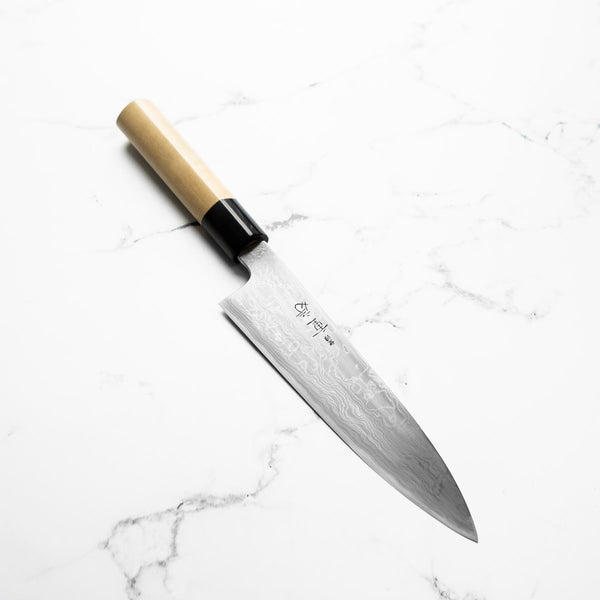
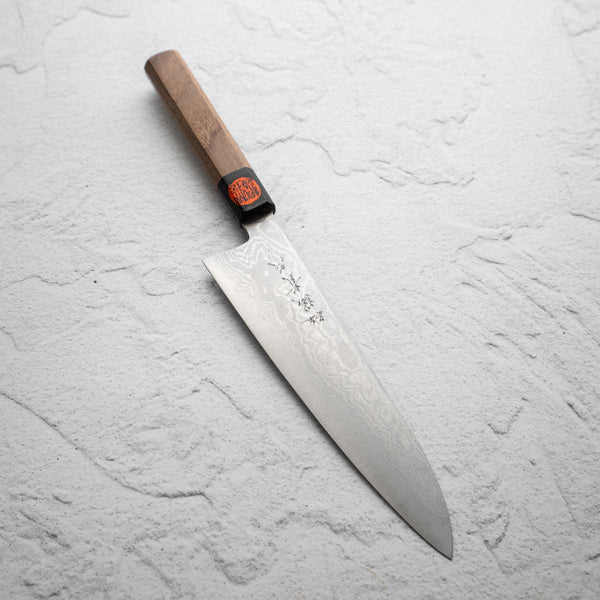
Specifications
| Style: | Gyuto |
| Blade Length: | 205mm |
| Overall Length: | 362mm |
| Weight: | 220g |
| Blade Height @ Heel: | 49mm |
| Bevel: | Double Bevel |
| Spine Thickness @ Mid: | 2.7mm |
| Blade Material: | Blue 1 Core, Soft Iron Damascus Clad |
| Handle Material: | Octagon Snakewood w/Blonde |
| HRC: | ~64 |
Nakagawa (Hatsukokoro) Blue 1 Migaki Gyuto 240mm - Double Blonde
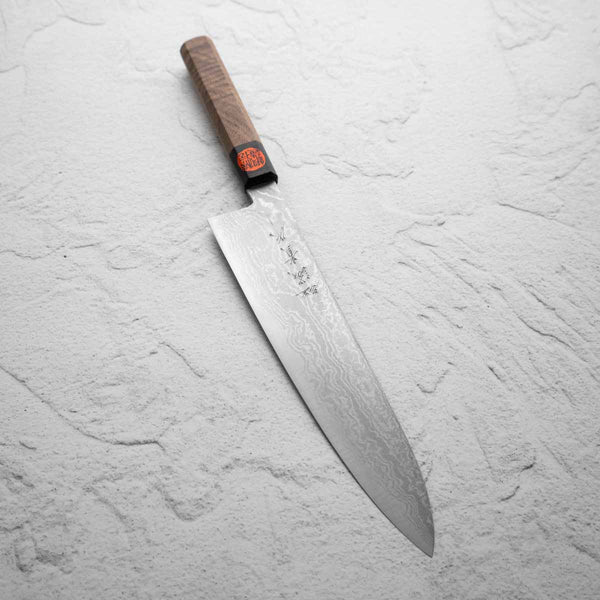
Specifications
| Style: | Gyuto |
| Blade Length: | 225mm |
| Overall Length: | 362mm |
| Weight: | 220g |
| Blade Height @ Heel: | 49mm |
| Bevel: | Double Bevel |
| Spine Thickness @ Mid: | 2.7mm |
| Blade Material: | Blue 1 Core, Soft Iron Damascus Clad |
| Handle Material: | Octagon Double Blonde |
| HRC: | ~64 |
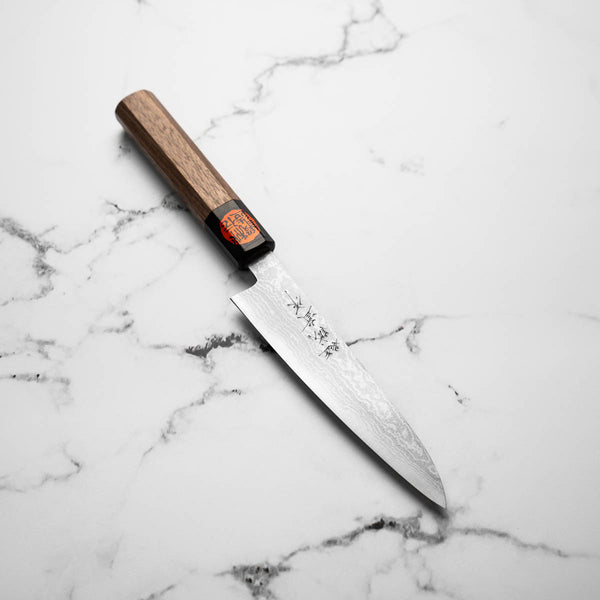
Specifications
| Style: | Petty |
| Blade Length: | 150mm |
| Overall Length: | 260mm |
| Weight: | 88g |
| Blade Height @ Heel: | 30mm |
| Bevel: | Double Bevel |
| Spine Thickness @ Mid: | 2.1mm |
| Blade Material: | Blue 1 Core, Soft Iron Damascus Clad |
| Handle Material: | Octagon Ebony |
| HRC: | ~64 |
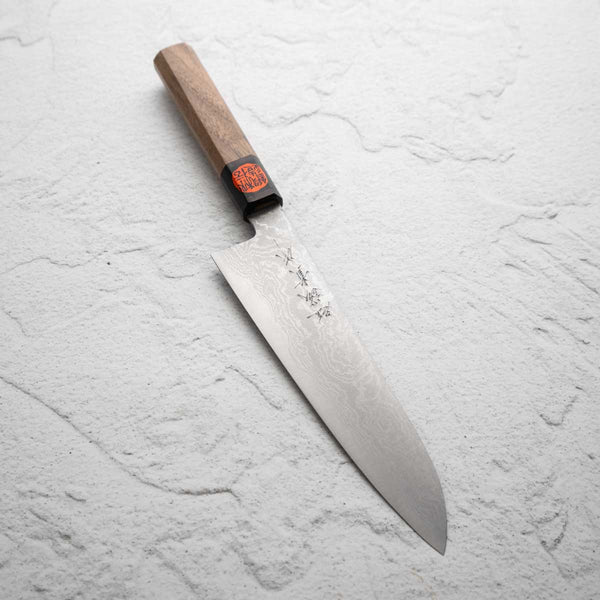
Specifications
| Style: | Gyuto |
| Blade Length: | 210mm |
| Overall Length: | 310mm |
| Weight: | 136g |
| Blade Height @ Heel: | 54mm |
| Bevel: | Double Bevel |
| Spine Thickness @ Mid: | 2mm |
| Blade Material: | Blue 1 Core, Soft Iron Damascus Clad |
| Handle Material: | Octagon Ebony |
| HRC: | ~64 |
Nakagawa Satoshi (Hatsukokoro) Blue 1 Damascus Petty 150mm - African Blackwood
Specifications
| Style: | Petty |
| Blade Length: | 150mm |
| Overall Length: | 260mm |
| Weight: | 88g |
| Blade Height @ Heel: | 30mm |
| Bevel: | Double Bevel |
| Spine Thickness @ Mid: | 2.1mm |
| Blade Material: | Blue 1 Core, Soft Iron Damascus Clad |
| Handle Material: | Octagon African Blackwood, Blonde Buffalo Horn |
| HRC: | ~64 |
Nakagawa Satoshi (Hatsukokoro) Blue 1 Damascus Petty 150mm - Double Blonde
Specifications
| Style: | Petty |
| Blade Length: | 145mm |
| Overall Length: | 260mm |
| Weight: | 85g |
| Blade Height @ Heel: | 30mm |
| Bevel: | Double Bevel |
| Spine Thickness @ Mid: | 2.1mm |
| Blade Material: | Blue 1 Core, Soft Iron Damascus Clad |
| Handle Material: | Octagon Double Blonde |
| HRC: | ~64 |
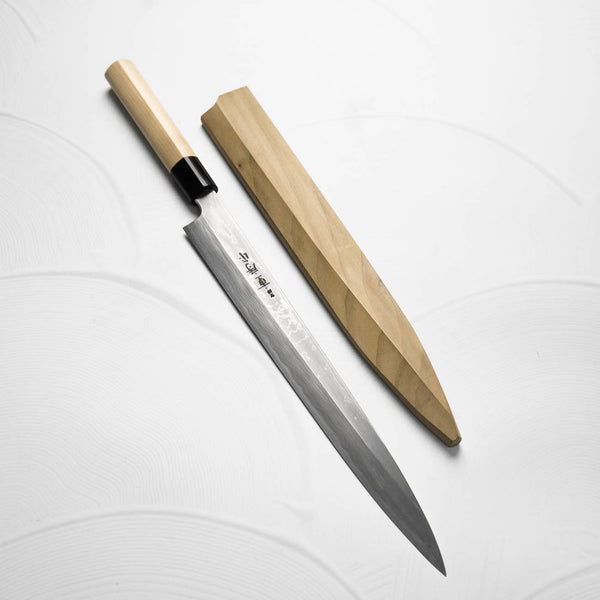
Specifications
| Style: | Yanagiba |
| Blade Length: | 200mm |
| Overall Length: | 342mm |
| Weight: | 119g |
| Blade Height @ Heel: | 30mm |
| Bevel: | Single Bevel |
| Spine Thickness @ Heel: | 3mm |
| Blade Material: | Ginsan Core w/Stainless Tsuchime Clad |
| Handle Material: | Octagon Walnut w/Pakka Wood Bolster |
| HRC: | ~61 |
Specifications
| Style: | Yanagiba |
| Blade Length: | 235mm |
| Overall Length: | 380mm |
| Weight: | 143g |
| Blade Height @ Heel: | 33mm |
| Bevel: | Single Bevel |
| Spine Thickness @ Heel: | 3mm |
| Blade Material: | Ginsan Core w/Stainless Tsuchime Clad |
| Handle Material: | Octagon Walnut w/Pakka Wood Bolster |
| HRC: | ~61 |
Specifications
| Style: | Yanagiba |
| Blade Length: | 265mm |
| Overall Length: | 410mm |
| Weight: | 176g |
| Blade Height @ Heel: | 33mm |
| Bevel: | Single Bevel |
| Spine Thickness @ Heel: | 3mm |
| Blade Material: | Ginsan Core w/Stainless Tsuchime Clad |
| Handle Material: | Octagon Walnut w/Pakka Wood Bolster |
| HRC: | ~61 |
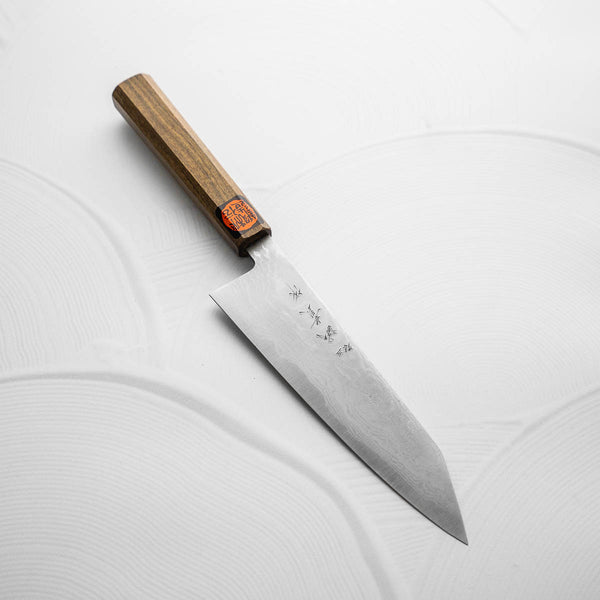
Specifications
| Style: | Petty |
| Blade Length: | 150mm |
| Overall Length: | 280mm |
| Weight: | 88g |
| Blade Height @ Heel: | 28mm |
| Bevel: | Double Bevel |
| Spine Thickness @ Mid: | 2.5mm |
| Blade Material: | Blue 1 Core, Soft Iron Damascus Clad |
| Handle Material: | Ebony w/ Blonde Buffalo Horn |
| HRC: | ~64 |
Nakagawa x Sakai Kikumori White 2 Mt Fuji Honyaki Gyuto 240mm
Specifications
| Artisan: | Satoshi Nakagawa |
| Style: | Honyaki Gyuto |
| Blade Length: | 232mm |
| Overall Length: | 395mm |
| Height @ Heel: | 44.5mm |
| Spine Thickness @ Heel: | 3.5mm |
| Spine Thickness @ Mid: | 2.5mm |
| Weight: | 189g |
| Blade Material: | White 2, Mt. Fuji Hamon, Mirror Finish Above Shinogi |
| Handle Material: | Traditional Urushi Lacquered Handle |
| HRC: | ~64 |
Chef's Edge
We pride ourselves on offering an unparalleled selection of Japanese knives. From the versatile Gyuto and the precise Santoku to specialized knives like the Nakiri and Yanagiba, each knife is handpicked for its quality and performance.