
April Release 2026

April's release features some ranges that are in extremely high demand! Takeda in particular have been out of stock for 18 months, so we're extremely glad to have them back, but no doubt they'll be gone in minutes. We welcome back restocks of Nigara Hamono, Hatsukokoro, Masutani and Morihei as well as new pieces from Nakagawa and Ashi Hamono. Enjoy!
Sort by:


Yoshikazu Ikeda White 1 Honyaki Kachikaeshi Gyuto 210mm - Dark Carbon Fibre
Yoshikazu Ikeda White 1 Honyaki Kachikaeshi Gyuto 210mm - Dark Carbon Fibre


Yoshikazu Ikeda White 1 Honyaki Kachikaeshi Gyuto 210mm - Ebony
Yoshikazu Ikeda White 1 Honyaki Kachikaeshi Gyuto 210mm - Ebony


Double thickness, heavy-duty canvas knife roll.
- Elastic loops
- 6 slots for knives/tools
- Fits knives with an overall length of 430mm
- Pocket width 65mm
- Leather-lined pocket ends for extra durability
- To be used in conjunction with blade guards
- Unfolded measurements: 650mm tall x 590mm wide


Double thickness, heavy-duty canvas knife roll.
- Elastic loops
- 6 slots for knives/tools
- Fits knives with an overall length of 430mm
- Pocket width 65mm
- Leather-lined pocket ends for extra durability
- To be used in conjunction with blade guards
- Unfolded measurements: 650mm tall x 590mm wide


Double thickness, heavy-duty canvas knife roll.
- Elastic loops
- 6 slots for knives/tools
- Steel rings
- Fits knives with an overall length of 430mm
- Pocket width 65mm
- Unfolded measurements: 650mm tall x 590mm wide


*AVAILABLE TO AUSTRALIAN CUSTOMERS ONLY*
Made in Japan
Specifications
Made in Agawa, Kochi Prefecture, Japan
Material: Wood-core covered with Polypropylene surface
Heat-Proof: 90°C (194°F)
Color: Black
34x23x1.8cm
About Hasegawa
Hasegawa are one of the biggest manufacturers of cutting boards in Japan. Their cutting boards are highly sought-after amongst hospitality professionals and home cooks alike for their antibacterial properties, wood cores that resist warping, and forgiving cutting feel.
Care
To prevent warping, it is recommended to place the board flat for storage. Not recommended for heavy chopping. Avoid handling fried foods on the surface as it becomes stained at a faster rate. Ultraviolet ray sterilization is not recommended as it may cause discoloration. Stop using immediately if the internal wood core structure is exposed to view. When stains become obvious, an appropriate amount of bleach can be used for cleaning. Keep away from fire of high temperature as it may cause deformation. Bleach Safe, Dishwasher Safe.

*AVAILABLE TO AUSTRALIAN CUSTOMERS ONLY*
Made in Japan
Specifications
Made in Agawa, Kochi Prefecture, Japan
Material: Wood-core covered with Polypropylene surface
Heat-Proof: 90°C (194°F)
Color: Yellow
34x23x2cm
About Hasegawa
Hasegawa are one of the biggest manufacturers of cutting boards in Japan. Their cutting boards are highly sought-after amongst hospitality professionals and home cooks alike for their antibacterial properties, wood cores that resist warping, and forgiving cutting feel.
Care
To prevent warping, it is recommended to place the board flat for storage. Not recommended for heavy chopping. Avoid handling fried foods on the surface as it becomes stained at a faster rate. Ultraviolet ray sterilization is not recommended as it may cause discoloration. Stop using immediately if the internal wood core structure is exposed to view. When stains become obvious, an appropriate amount of bleach can be used for cleaning. Keep away from fire of high temperature as it may cause deformation. Bleach Safe, Dishwasher Safe.
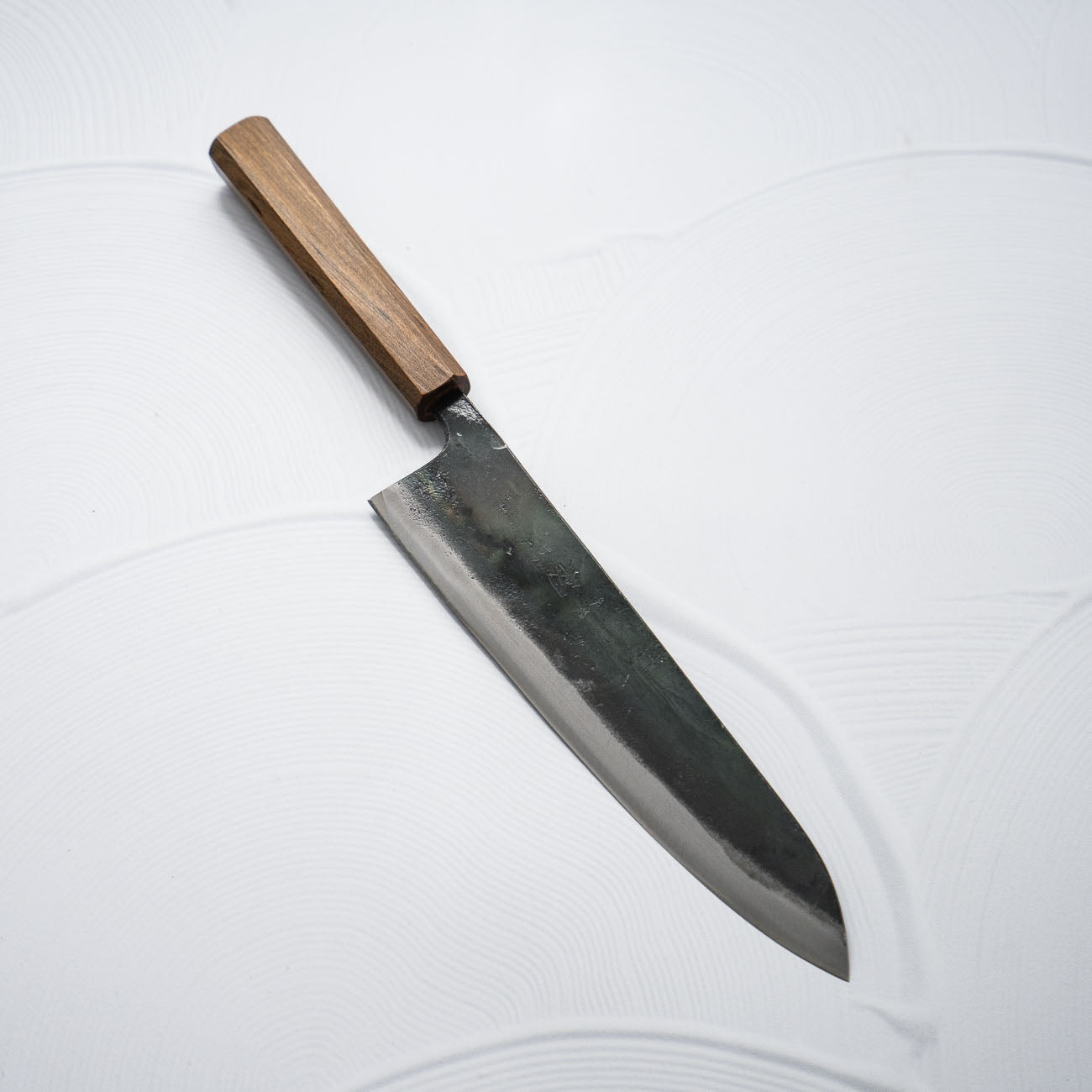

Specifications
| Style: | Gyuto |
| Blade Length: | 210mm |
| Overall Length: | 360mm |
| Weight: | 180g |
| Blade Height @ Heel: | 48mm |
| Bevel: | Double Bevel |
| Spine Thickness @ Heel: | 3mm |
| Spine Thickness @ Mid: | 2mm |
| Spine Thickness 1cm from tip: | 1.8mm |
| Blade Material: | Blue 1 Core, Kurouchi Iron Clad |
| HRC: | 63 |
| Handle: | Octagon Bubinga |
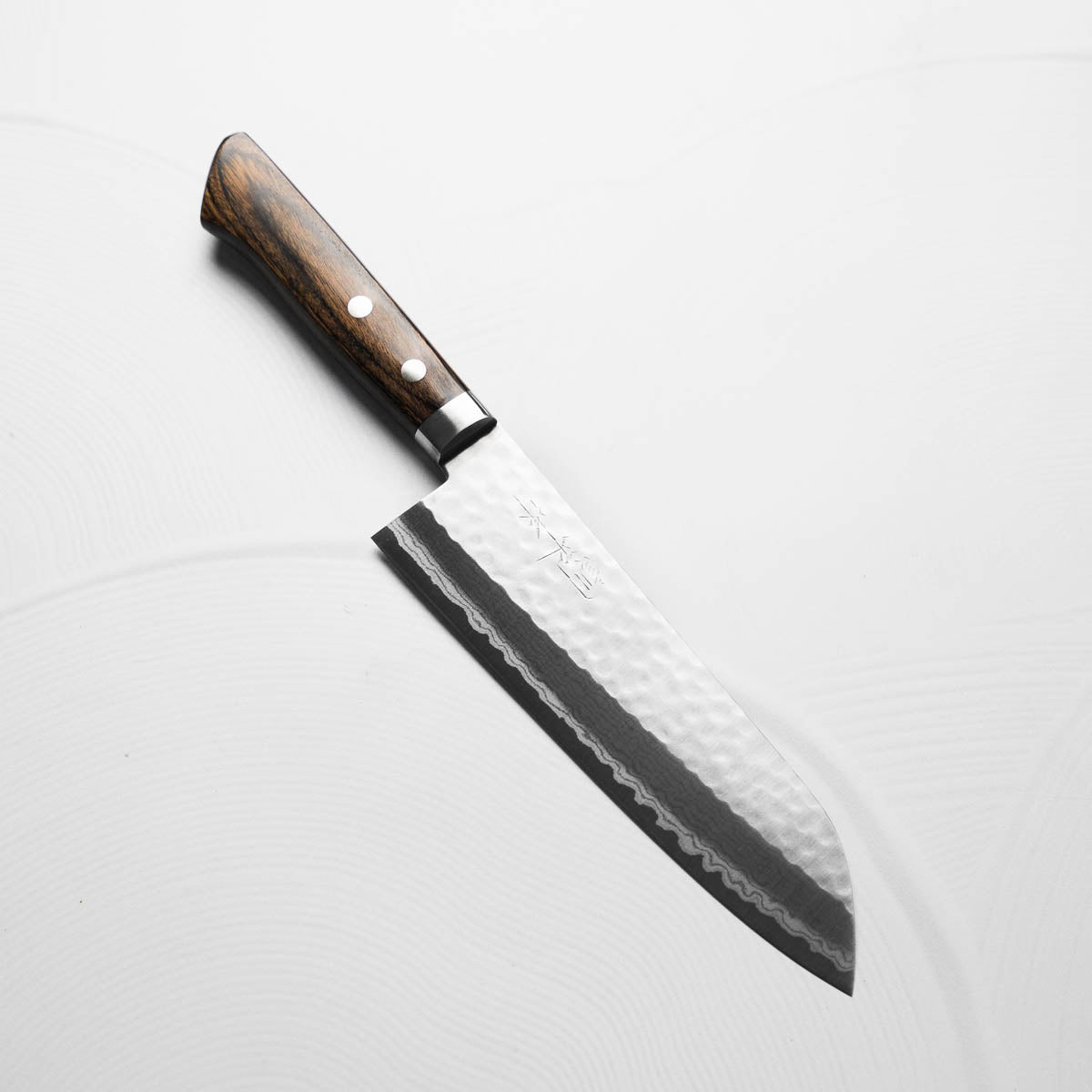

Specifications
| Style: | Santoku |
| Blade Length: | 170mm |
| Overall Length: | 295mm |
| Weight: | 142g |
| Blade Height @ Heel: | 47mm |
| Bevel: | Double Bevel |
| Spine Thickness @ Mid: | 1.8mm |
| Blade Material: | VG10, Stainless Tsuchime Clad |
| Handle Material: | Western Pakka Wood |
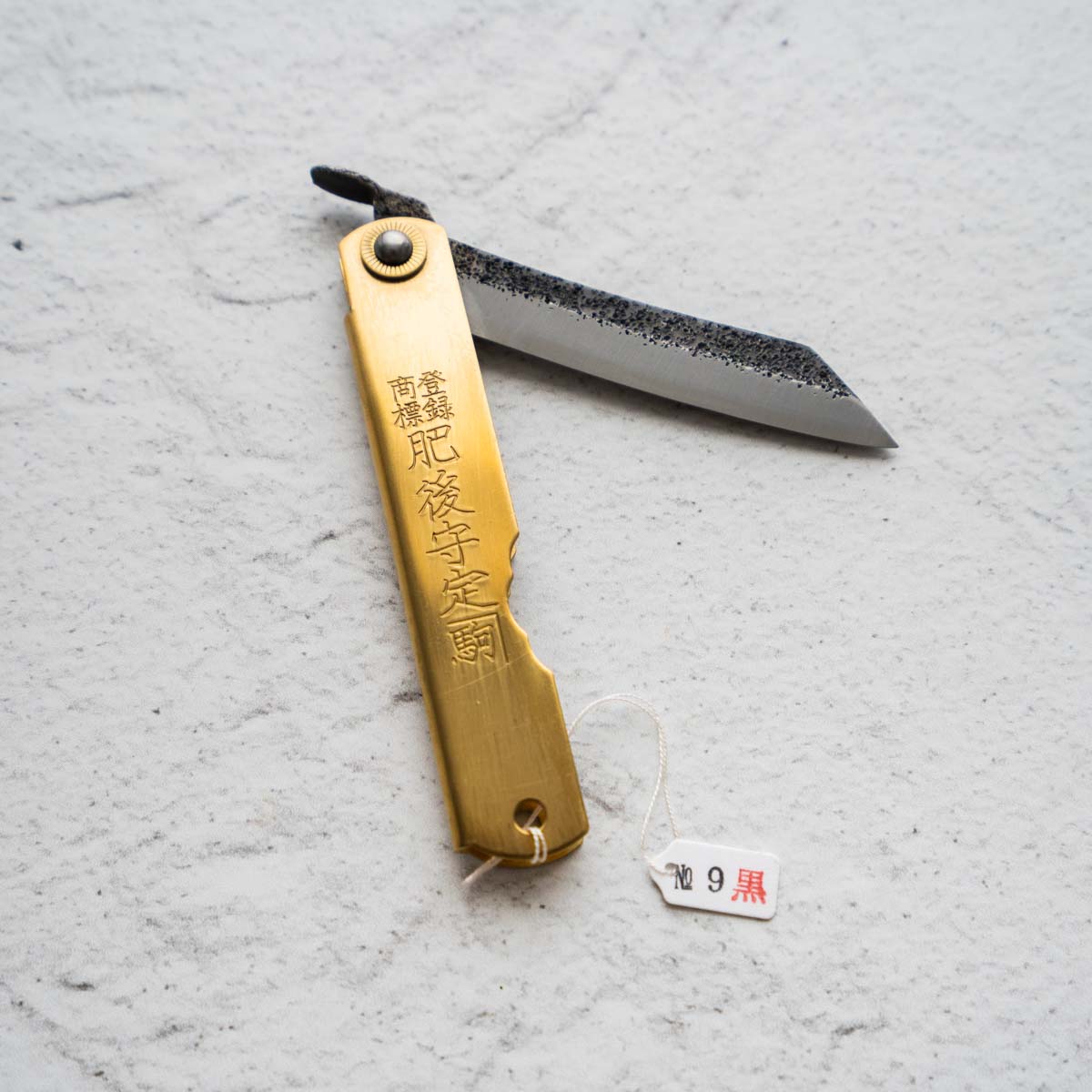
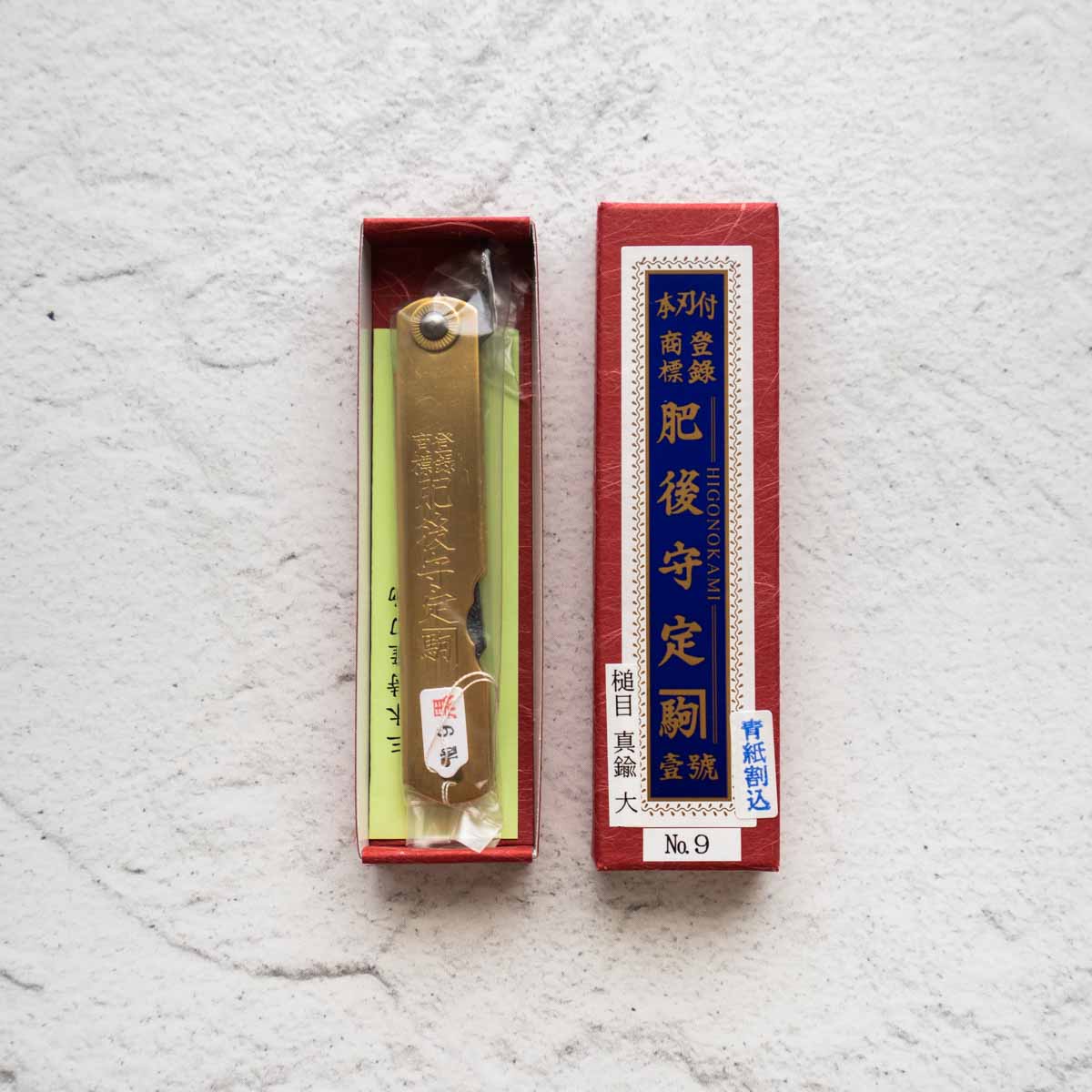
Knife Information
1894- Mr. Tasaburo Shigematsu, a hardware wholesaler, introduced a new pocket knife with its blade and sheath folded by installing a small handle “Chikiri (tail)” on the blade, while inspired by the knife he brought back from Kagoshima.
He named it “Higonokami Knife” because many of his customers were in Kumamoto area (formally Higo country), which turned out to dramatically increase his sales. The blades have gradually changed their shapes. Unlike single-edged knives, the double-edged blades (V-shaped cross section) were in those days considered common. The earlier blades had a sharper tip (shape of a bamboo leaf), but now they have square shapes. The sheaths had a vertically folding style and a cross folding style, now the vertical one has to be custom made.
In 1911, at the First Kobe Export Articles Competitive Exhibition, Crown Prince (later Emperor Taisho) liked Higonokami on display very much and bought one, which is said to have helped its fame further spread.
The Higonikami is a fantastic traditional utility knife at a low cost.
Specifications
| Style: | Higonokami |
| Blade Length: | 70mm |
| Weight: | 49g |
| Bevel: | Double Bevel |
| Blade Material: | Aogami (Blue) Steel w/Kurouchi Finish |
| Handle Material: | Brass |
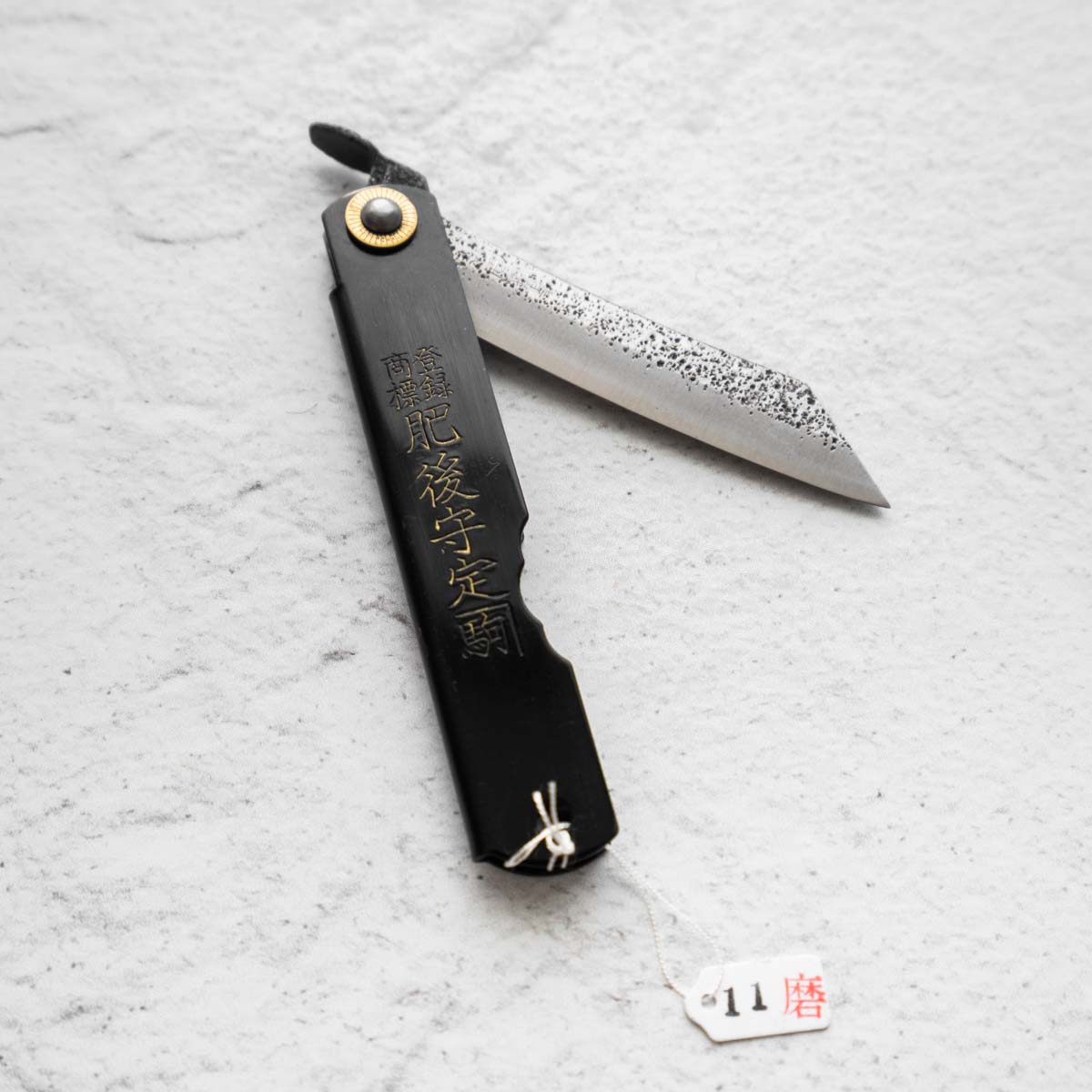
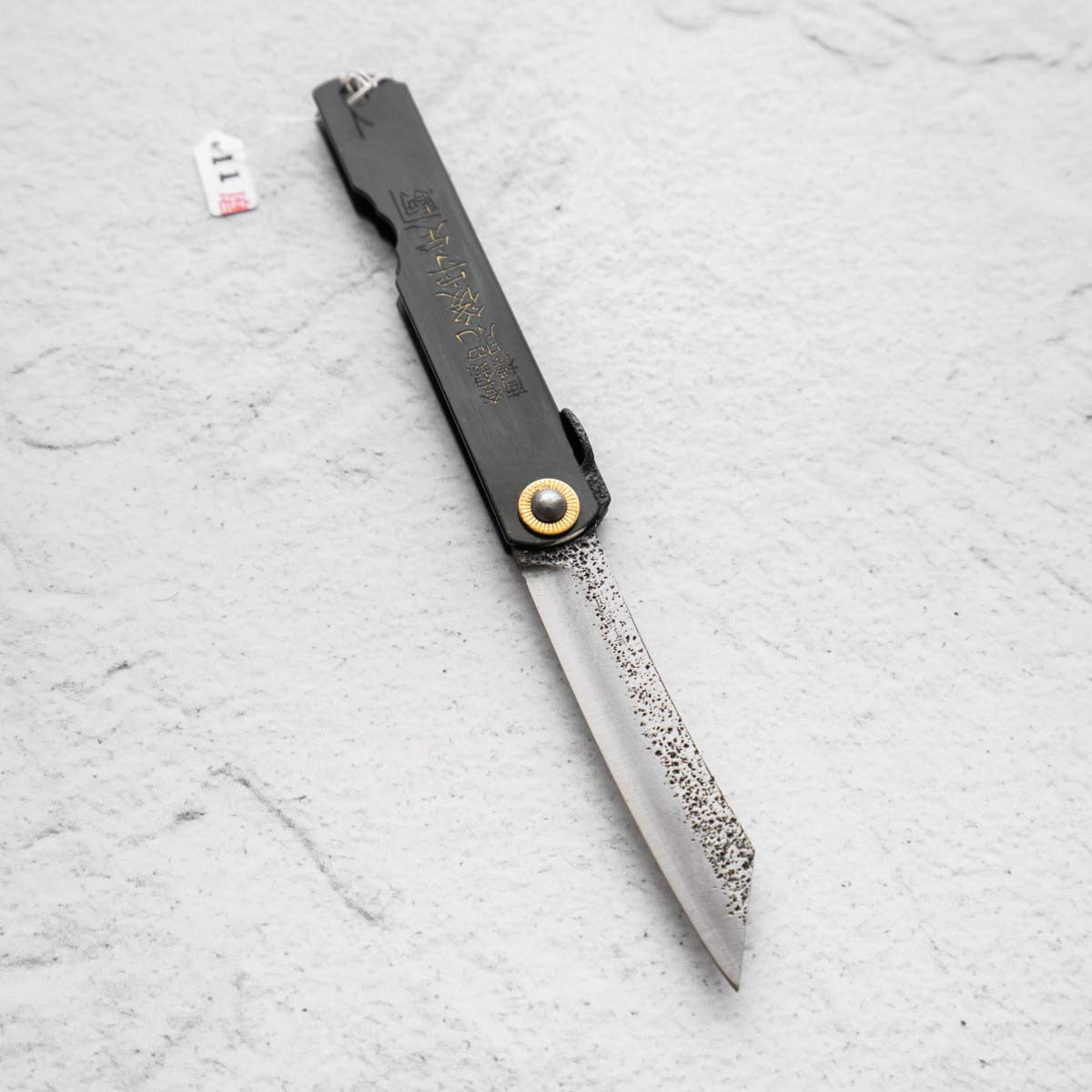
Knife Information
1894- Mr. Tasaburo Shigematsu, a hardware wholesaler, introduced a new pocket knife with its blade and sheath folded by installing a small handle “Chikiri (tail)” on the blade, while inspired by the knife he brought back from Kagoshima.
He named it “Higonokami Knife” because many of his customers were in Kumamoto area (formally Higo country), which turned out to dramatically increase his sales. The blades have gradually changed their shapes. Unlike single-edged knives, the double-edged blades (V-shaped cross section) were in those days considered common. The earlier blades had a sharper tip (shape of a bamboo leaf), but now they have square shapes. The sheaths had a vertically folding style and a cross folding style, now the vertical one has to be custom made.
In 1911, at the First Kobe Export Articles Competitive Exhibition, Crown Prince (later Emperor Taisho) liked Higonokami on display very much and bought one, which is said to have helped its fame further spread.
The Higonikami is a fantastic traditional utility knife at a low cost.
Specifications
| Style: | Higonokami |
| Blade Length: | 70mm |
| Weight: | 50g |
| Bevel: | Double Bevel |
| Blade Material: | Aogami (Blue) Steel |
| Handle Material: | Engraved Brass w/hand-polished Black coating |
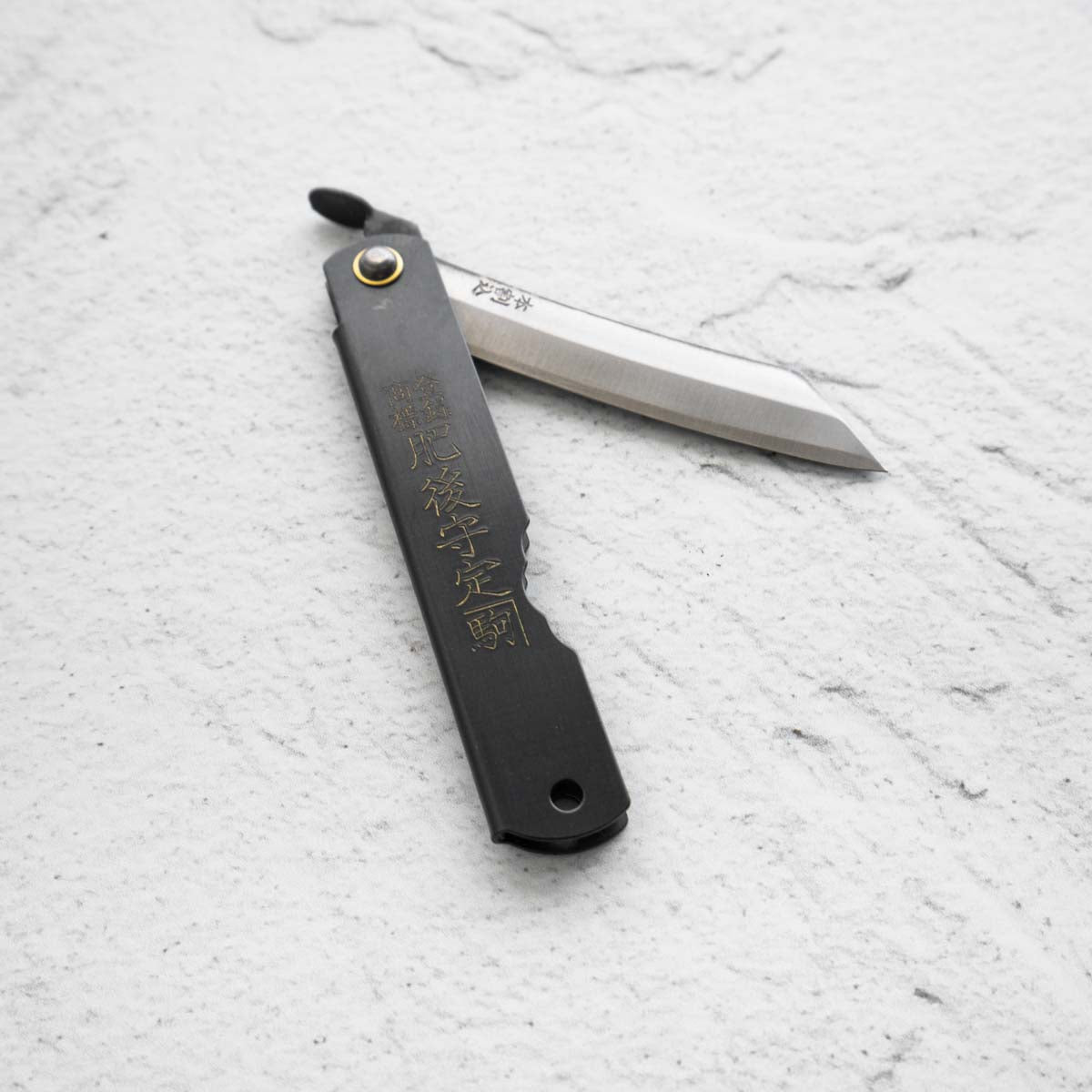
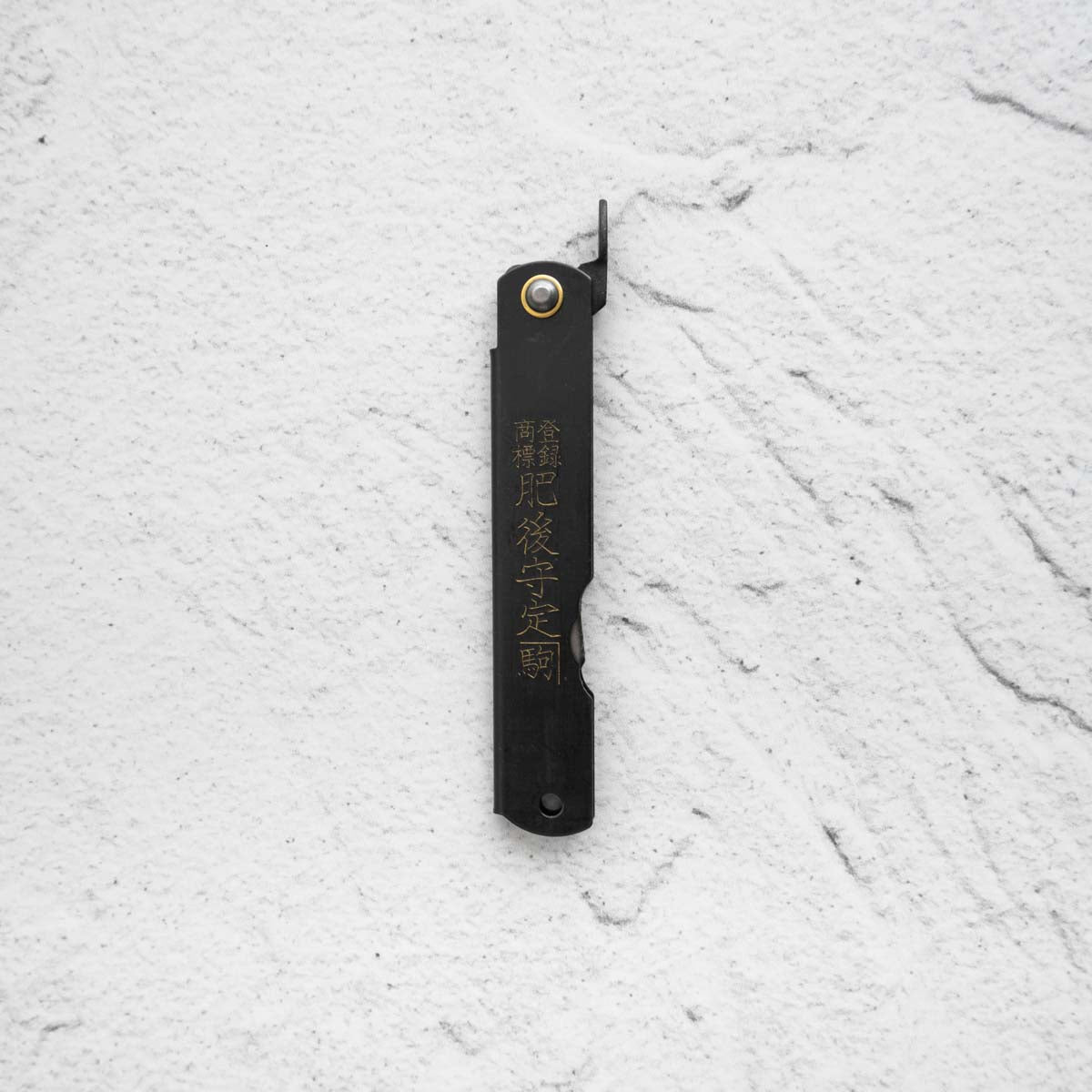
Knife Information
1894- Mr. Tasaburo Shigematsu, a hardware wholesaler, introduced a new pocket knife with its blade and sheath folded by installing a small handle “Chikiri (tail)” on the blade, while inspired by the knife he brought back from Kagoshima.
He named it “Higonokami Knife” because many of his customers were in Kumamoto area (formally Higo country), which turned out to dramatically increase his sales. The blades have gradually changed their shapes. Unlike single-edged knives, the double-edged blades (V-shaped cross section) were in those days considered common. The earlier blades had a sharper tip (shape of a bamboo leaf), but now they have square shapes. The sheaths had a vertically folding style and a cross folding style, now the vertical one has to be custom made.
In 1911, at the First Kobe Export Articles Competitive Exhibition, Crown Prince (later Emperor Taisho) liked Higonokami on display very much and bought one, which is said to have helped its fame further spread.
The Higonikami is a fantastic traditional utility knife at a low cost.
Specifications
| Style: | Higonokami |
| Blade Length: | 74mm |
| Weight: | 53g |
| Bevel: | Double Bevel |
| Blade Material: | Laminated SK Carbon Steel |
| Handle Material: | Black Nickel |
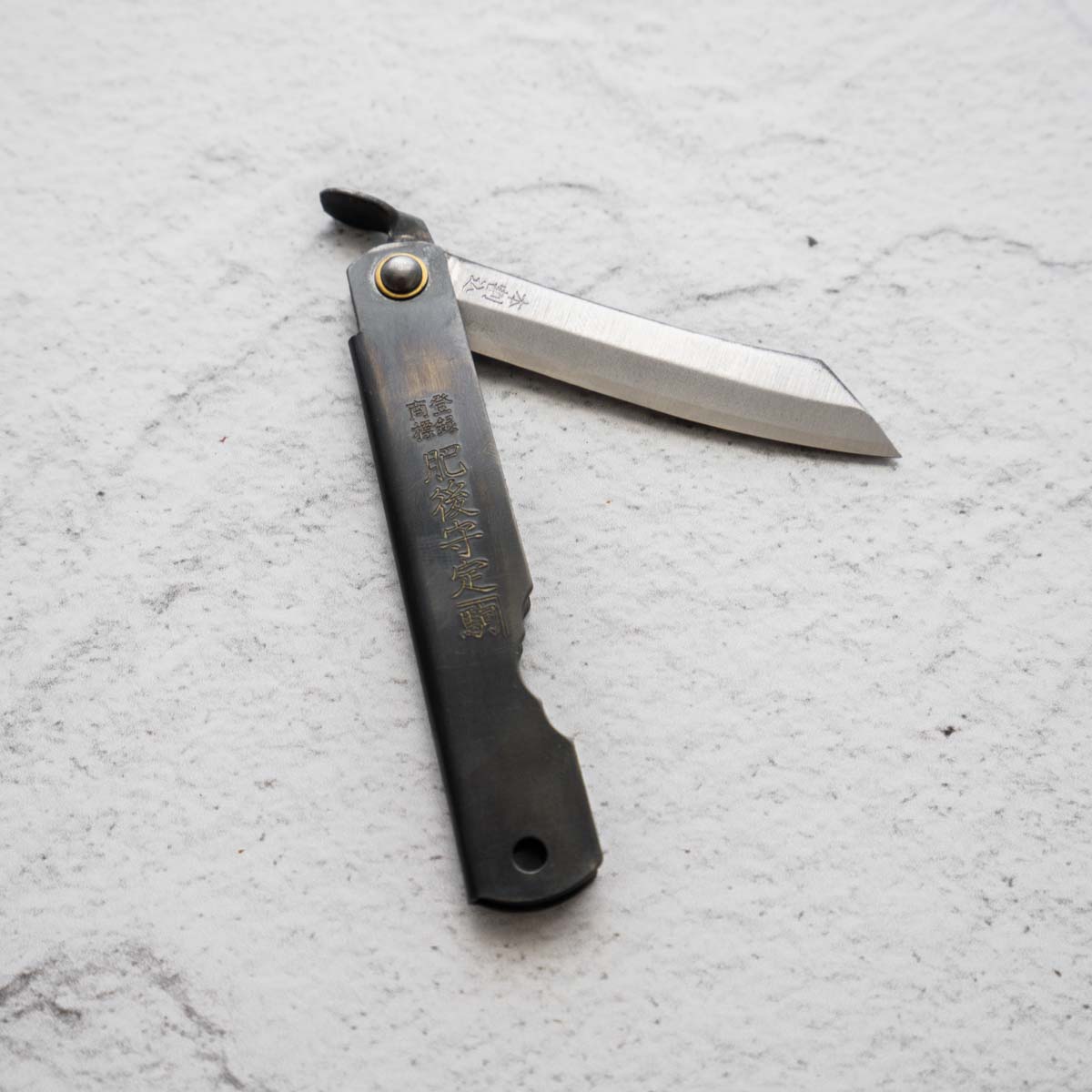
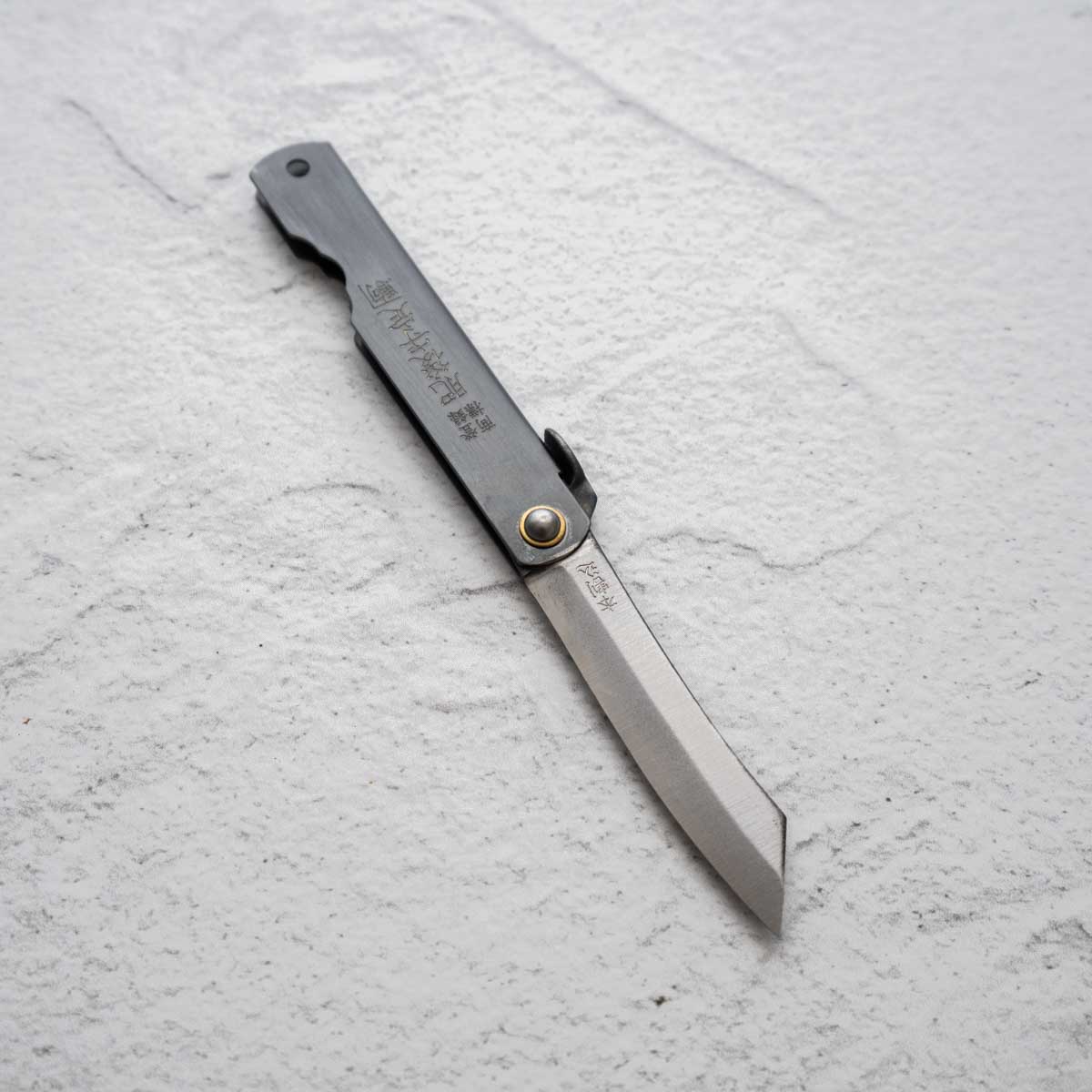
Knife Information
1894- Mr. Tasaburo Shigematsu, a hardware wholesaler, introduced a new pocket knife with its blade and sheath folded by installing a small handle “Chikiri (tail)” on the blade, while inspired by the knife he brought back from Kagoshima.
He named it “Higonokami Knife” because many of his customers were in Kumamoto area (formally Higo country), which turned out to dramatically increase his sales. The blades have gradually changed their shapes. Unlike single-edged knives, the double-edged blades (V-shaped cross section) were in those days considered common. The earlier blades had a sharper tip (shape of a bamboo leaf), but now they have square shapes. The sheaths had a vertically folding style and a cross folding style, now the vertical one has to be custom made.
In 1911, at the First Kobe Export Articles Competitive Exhibition, Crown Prince (later Emperor Taisho) liked Higonokami on display very much and bought one, which is said to have helped its fame further spread.
The Higonikami is a fantastic traditional utility knife at a low cost.
Specifications
| Style: | Higonokami |
| Blade Length: | 65mm |
| Weight: | 33g |
| Bevel: | Double Bevel |
| Blade Material: | Laminated SK Carbon Steel |
| Handle Material: | Black Nickel |


Nagao Kanekoma Higonokami VG10 Custom - Black Persimmon- No 50
Nagao Kanekoma Higonokami VG10 Custom - Black Persimmon- No 50
Knife Information
1894- Mr. Tasaburo Shigematsu, a hardware wholesaler, introduced a new pocket knife with its blade and sheath folded by installing a small handle “Chikiri (tail)” on the blade, while inspired by the knife he brought back from Kagoshima.
He named it “Higonokami Knife” because many of his customers were in Kumamoto area (formally Higo country), which turned out to dramatically increase his sales. The blades have gradually changed their shapes. Unlike single-edged knives, the double-edged blades (V-shaped cross section) were in those days considered common. The earlier blades had a sharper tip (shape of a bamboo leaf), but now they have square shapes. The sheaths had a vertically folding style and a cross folding style, now the vertical one has to be custom made.
In 1911, at the First Kobe Export Articles Competitive Exhibition, Crown Prince (later Emperor Taisho) liked Higonokami on display very much and bought one, which is said to have helped its fame further spread.
The Higonikami is a fantastic traditional utility knife at a low cost.
Specifications
| Style: | Higonokami |
| Blade Length: | 70mm |
| Weight: | 32g |
| Bevel: | Double Bevel |
| Blade Material: | VG10 Stainless Steel |
| Handle Material: | Custom Engraved Black Persimmon |
Chef's Edge
We pride ourselves on offering an unparalleled selection of Japanese knives. From the versatile Gyuto and the precise Santoku to specialized knives like the Nakiri and Yanagiba, each knife is handpicked for its quality and performance.